


Tierra Stanback | Westchester Real Estate
Westchester Real Estate by Metro-North Line
For many buyers moving from New York City to Westchester, the train line is not a small detail. It shapes the commute, the towns you compare, the type of home you consider, and what daily life may feel like after the move.
Use this guide to compare Westchester towns along the Harlem, Hudson, and New Haven lines, then explore the local real estate guides connected to each stop.
Buying in Westchester Ask Tierra About Commuter-Friendly TownsCommuter-Focused Home Search
Choosing a Westchester Town Often Starts With the Train
Metro-North access is one of the biggest filters for buyers comparing Westchester County. But the right town is not only about the number of minutes to Grand Central. Station access, parking, express service, fares, housing type, taxes, school district, weekend plans, and daily errands all shape the decision.
Commute Pattern
Daily commuter, hybrid schedule, occasional city trip, or weekend rider? The right station may change depending on how often and when you travel.
Station Access
A town may have train access, but the actual routine depends on whether you walk, drive, get dropped off, take a bus, use ride-share, or need parking.
Housing Type
Some station areas have more condos, co-ops, and townhomes. Others lean toward single-family homes, larger properties, or quieter residential settings.
Total Cost
Price, taxes, common charges, maintenance, parking costs, ticket costs, and commute frequency should all be part of the comparison.
Visual Guide
Metro-North Lines Through Westchester
Use this guide map to see how the Harlem, Hudson, and New Haven lines move through Westchester before exploring the clickable station links below.
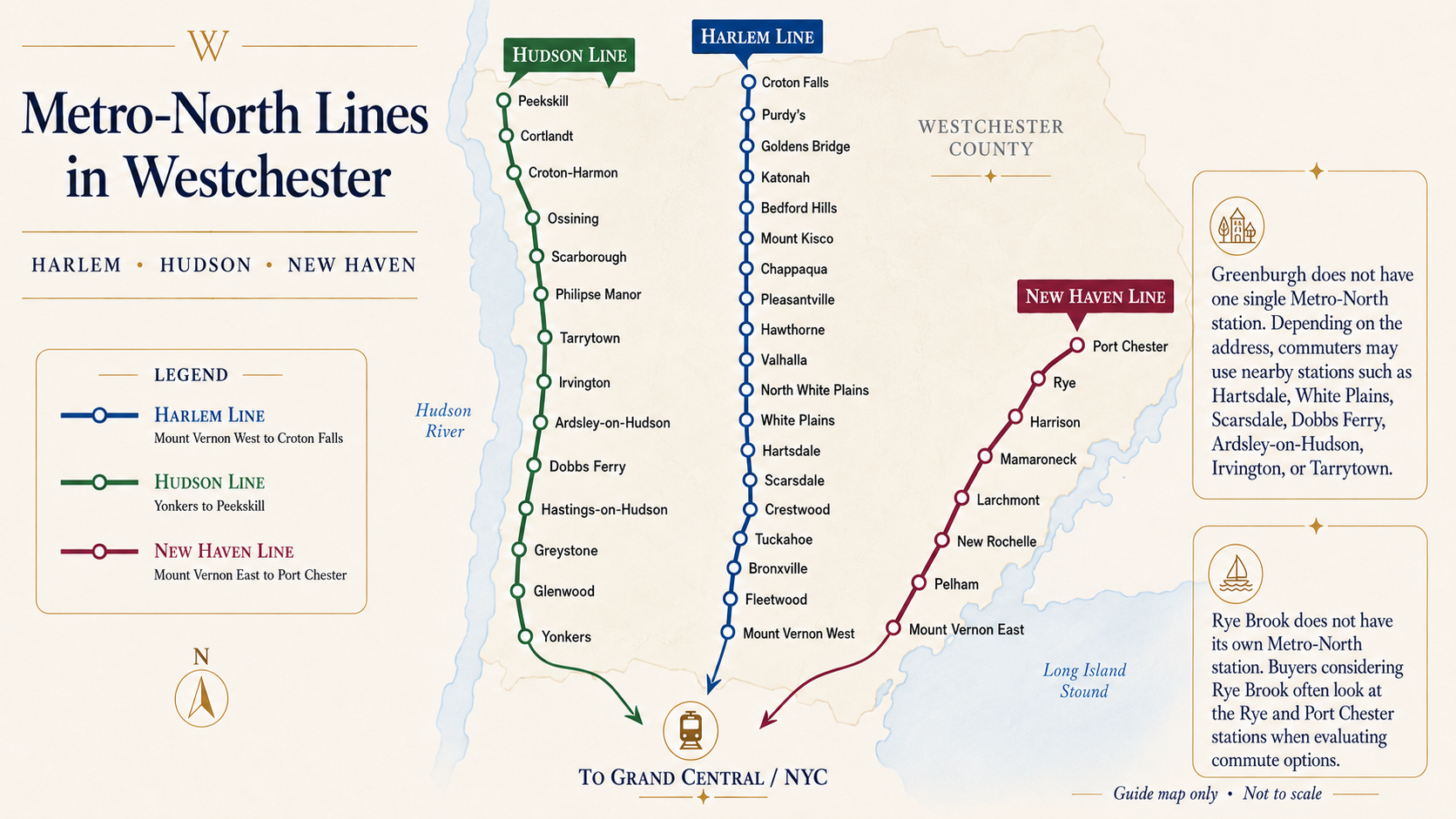
Guide map only. Not to scale. Always verify current schedules, fares, parking, and service details with the MTA or the appropriate station parking provider.
Every Stop, Three Lines Home
This clickable guide organizes Westchester Metro-North towns by line. Live town guides are linked below. Station guides still being built are shown in lighter pills so this page can continue growing into a full commuter real estate map.
Harlem Line
19 stops in WestchesterRuns through the center of the county, connecting central Westchester towns from Bronxville and Scarsdale through White Plains, Hartsdale, Chappaqua, Mount Kisco, Katonah, and beyond.
Greenburgh does not have one single Metro-North station. Depending on the address, commuters may use nearby stations such as Hartsdale, White Plains, Scarsdale, Dobbs Ferry, Ardsley-on-Hudson, Irvington, or Tarrytown.
Hudson Line
14 stops in WestchesterFollows the Hudson River north through Yonkers, Hastings-on-Hudson, Dobbs Ferry, Irvington, Tarrytown, Ossining, Croton-Harmon, Peekskill, and other river corridor station areas.
New Haven Line
8 stops in WestchesterRuns along the southern edge of the county toward Connecticut, connecting Mount Vernon East, Pelham, New Rochelle, Larchmont, Mamaroneck, Harrison, Rye, and Port Chester.
Rye Brook does not have its own Metro-North station. Buyers considering Rye Brook often look at the Rye and Port Chester stations when evaluating commute options. Explore the Rye Brook Real Estate Guide.
Line-by-Line
What the Three Metro-North Lines Mean for Buyers
Each line gives buyers a different version of Westchester. The right fit depends on commute routine, property type, station access, price range, and what kind of setting you want when you step off the train.
Harlem Line
The Harlem Line runs through central Westchester and is often a major focus for buyers comparing Bronxville, Scarsdale, Hartsdale, White Plains, Chappaqua, Mount Kisco, Katonah, and nearby Greenburgh communities.
Harlem Line Westchester Real Estate Guide →Hudson Line
The Hudson Line follows the river and is often attractive to buyers drawn to river towns, village centers, scenic train rides, and communities such as Yonkers, Hastings, Dobbs Ferry, Irvington, Tarrytown, Ossining, and Peekskill.
Hudson Line Westchester Real Estate Guide →New Haven Line
The New Haven Line connects Sound Shore communities and Connecticut-adjacent markets, including New Rochelle, Larchmont, Mamaroneck, Harrison, Rye, Port Chester, and nearby Rye Brook.
New Haven Line Westchester Real Estate Guide →Practical Commuter Details
Schedules, Fares, Parking, and Station Access All Matter
The individual line guides go deeper, but every buyer should understand that Metro-North decisions are not only about the closest station on a map.
Schedules and Express Service
Train patterns can vary by line, station, direction, time of day, and schedule period. Express and local service can make two similar-looking stations feel very different.
Fares and Monthly Passes
Metro-North uses a zone-based fare system. Ticket cost depends on station, peak or off-peak travel, and whether you buy one-way, weekly, or monthly tickets.
Parking and Permits
Parking may be municipal, privately managed, permit-based, waitlisted, app-based, metered, daily, or limited by station. Always verify before relying on it.
Test the Commute
Before choosing a home around a train line, test the actual trip at the time you expect to travel and include the time it takes to reach the station.
This Hub Is the Starting Point
The Metro-North hub gives you the big-picture map. The Harlem, Hudson, and New Haven line guides go deeper into commute patterns, station-by-station context, fare planning, parking considerations, history, and the local real estate pages connected to each stop.
Official Commuter Resources
Verify the Details Before You Decide
Schedules, fares, service patterns, parking rules, permit availability, payment apps, and station access can change. Use official resources before making a housing decision around a specific commute.
Official MTA Schedules MTA Fares and Ticket Info MTA TrainTime Metro-North Parking InfoThis page is an independent real estate guide and is not an official MTA map, schedule, fare table, or parking resource.
Nearby Station Towns
Some Great Westchester Areas Do Not Have Their Own Station
A town or neighborhood does not need its own train stop to be commuter-friendly. Many buyers compare homes based on the nearest practical station, parking options, driving time, and daily routine.
Greenburgh
Greenburgh buyers may use different stations depending on the address, including Hartsdale, White Plains, Scarsdale, Dobbs Ferry, Ardsley-on-Hudson, Irvington, or Tarrytown.
Greenburgh Seller Guide →Rye Brook
Rye Brook does not have its own Metro-North station. Buyers considering Rye Brook often look at the Rye and Port Chester stations when evaluating commute options.
Rye Brook Real Estate Guide →Purchase
Purchase is often evaluated with nearby Harrison, White Plains, Rye, or Port Chester access depending on the property location and commute routine.
Harrison Real Estate Guide →Ardsley
Ardsley buyers may compare Dobbs Ferry, Ardsley-on-Hudson, or other nearby river-town station options depending on the address.
Ask About Ardsley Commute Options →Local Real Estate Guide Network
Connected Westchester Area Guides
These local guides are already part of Tierra’s Westchester real estate resource network and connect directly to the Metro-North commuter search experience.
White Plains
A central Harlem Line anchor with downtown living, condos, co-ops, single-family neighborhoods, shopping, dining, and strong commuter access.
White Plains Real Estate Guide →Hartsdale
A practical central Westchester option for buyers comparing train access, Greenburgh context, condo/co-op options, and nearby neighborhoods.
Hartsdale Real Estate Guide →Scarsdale
A well-known Harlem Line market where station access, school district, property type, taxes, and lifestyle all need to be evaluated carefully.
Scarsdale Real Estate Guide →Bronxville
A lower Westchester village market with strong train access and a distinct housing profile close to New York City.
Bronxville Real Estate Guide →Yonkers
A major Westchester city with Hudson Line access, multiple neighborhoods, varied housing types, and proximity to New York City.
Yonkers Real Estate Guide →New Rochelle
A New Haven Line city with transit access, downtown growth, waterfront context, condos, co-ops, and single-family neighborhoods.
New Rochelle Real Estate Guide →Mamaroneck
A Sound Shore community on the New Haven Line with village, waterfront, and commuter appeal.
Mamaroneck Real Estate Guide →Harrison
A New Haven Line market that can also connect buyers to Purchase, nearby shopping, schools, and major road access.
Harrison Real Estate Guide →Rye Brook
A strong nearby market often evaluated through the Rye and Port Chester stations even though it does not have its own Metro-North stop.
Rye Brook Real Estate Guide →Station Guide Buildout
More Metro-North Town Guides Are Coming
This guide network is being built in phases so buyers can compare Westchester towns by commute, housing type, price point, and daily routine.
Priority Town Guides
Rye, Port Chester, Larchmont, Pelham, Tuckahoe, Pleasantville, Valhalla, Mount Kisco, Katonah, Tarrytown, Dobbs Ferry, Irvington, and Hastings-on-Hudson.
Future Station-Area Guides
Fleetwood, Crestwood, North White Plains, Hawthorne, Glenwood, Greystone, Ardsley-on-Hudson, Philipse Manor, Scarborough, Goldens Bridge, Purdy’s, and Croton Falls may become shorter commuter station guides first.
How the Pages Connect
The hub links to the line guides. The line guides link to the town and station pages. The town pages will link back to the relevant train line, creating a stronger local search ecosystem.
Questions Buyers Ask
Westchester Metro-North Real Estate FAQ
These are common questions buyers ask when using Metro-North access to compare Westchester towns.
Which Metro-North lines serve Westchester County?
Westchester County is served by the Harlem Line, Hudson Line, and New Haven Line. Each line connects different towns and station areas to Grand Central Terminal and New York City.
Should I choose a Westchester town based only on train time?
No. Train time is important, but it is only one part of the decision. Buyers should also compare station access, parking, housing type, property taxes, school district, local amenities, price range, and daily routine.
Which line is best for central Westchester?
The Harlem Line is often a strong starting point for central Westchester because it connects areas such as Bronxville, Scarsdale, Hartsdale, White Plains, Chappaqua, Mount Kisco, Katonah, and nearby Greenburgh communities.
Which line is best for river towns?
The Hudson Line follows the Hudson River and serves communities such as Yonkers, Hastings-on-Hudson, Dobbs Ferry, Irvington, Tarrytown, Ossining, Croton-Harmon, Cortlandt, and Peekskill.
Which line is best for Sound Shore towns?
The New Haven Line serves southern and Sound Shore communities such as Mount Vernon East, Pelham, New Rochelle, Larchmont, Mamaroneck, Harrison, Rye, and Port Chester.
Do all Westchester towns have their own Metro-North station?
No. Some towns and neighborhoods rely on nearby stations. For example, Greenburgh residents may use different nearby stations depending on the address, while Rye Brook buyers often evaluate the Rye and Port Chester stations.
Is parking guaranteed at Metro-North stations?
No. Parking varies by station, municipality, permit rules, lot operator, payment system, and availability. Always verify parking directly before relying on a station for a daily commute.
Local Guidance
Meet Tierra Stanback
Tierra Stanback is a Licensed Real Estate Salesperson with eXp Realty Luxury and The Price Team, serving White Plains, Westchester County, the Lower Hudson Valley, and nearby Connecticut. If you are comparing Westchester towns by commute, property type, price point, station access, and daily routine, Tierra can help you think through the practical details before you narrow your search.
Westchester Real Estate Guidance
Trying to Choose the Right Westchester Train Town?
A commute can look simple on a map and feel completely different in real life. Tierra can help you compare towns, stations, property types, pricing, and daily logistics before you narrow your search.
Ask Tierra About Commuter-Friendly Towns Read the Westchester Buyer Guide